Prince Arthur's Welsh Council
The Constant PrincessPrince Arthur's Welsh Council is the governing and advisory body based at Ludlow Castle during Arthur, Prince of Wales’s residence there. The novel presents it not through a formal charter or a complete account of its procedures, but through its chambers, officers, and the work of counsel: receiving approaches from powerful men, addressing local disputes, and pursuing Arthur’s aim of extending the law across the principality. Its importance lies in the contrast between the orderly government Arthur seeks and the fragmented authority of the borderlands he is charged with governing.
Setting and Composition
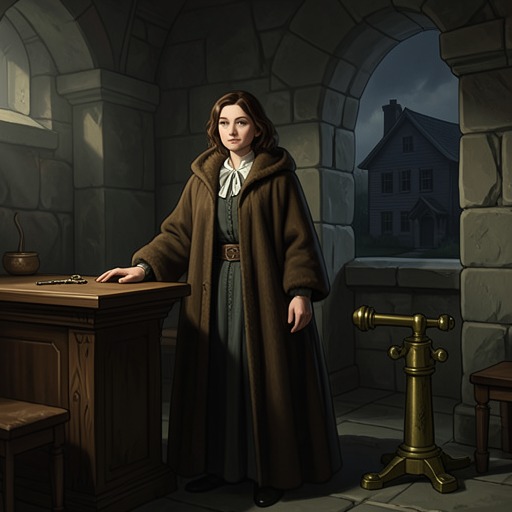
The council’s chambers occupy a defined place in the castle’s working arrangement. Introducing Catalina of Aragon to the great hall, Arthur points out that the Welsh council chambers are to its left, with his own rooms above them. The layout places the business of government close to the prince’s household, but gives it a distinct institutional space within the castle. Rooms for the castle’s warden and his lady are also described in connection with this part of the building, linking the council’s setting to the people responsible for the castle’s administration.
The account names a substantial group of officers around Arthur. Sir Richard Pole is identified as his chamberlain; Bishop William Smith of Lincoln as warden of the castle; Dr. Bereworth as his physician; Sir Henry Vernon as treasurer; Sir Richard Croft as steward of the household; and Sir William Thomas of Carmarthen as groom of the privy chamber. These officials sit among the leading men of the principality in the great hall. The novel does not specify a full membership list or explain each officer’s council duties, so the council appears as part of a wider governing household rather than as a body whose formal constitution is exhaustively defined.
Business and Governing Methods
Arthur’s council operates amid persistent demands for his attention. Even after the evening’s entertainment, men seek his counsel and petition him for favors, land, or influence. These approaches show government as a continual personal obligation: Arthur must listen and negotiate with those whose local power affects whether his authority can be made effective. The proceedings are not presented as detached deliberation in a distant capital, but as counsel embedded in the prince’s daily life at Ludlow.
The setting makes that work difficult. The rule of law barely reaches the borderlands; individual landowners exercise authority like warlords, while in the mountains some people still believe Richard remains on the throne, speak no English, and obey no laws. Arthur’s response is to argue, praise, and propose practical remedies. Feuds should be forgiven, trespasses made good, and Welsh chieftains should cooperate rather than squander their strength in envy. His stated purpose is to make the law run throughout the land and to replace divided, personal power with a more dependable public order.
Political Vision and Debate
Arthur’s programme is not simply a matter of imposing commands. He tries to persuade local leaders to settle grievances and work together, connecting legal order with the prosperity of the country. The council’s work therefore joins immediate negotiation—favor, land, feud, and restitution—to a larger project of political integration. The valleys and coastal lands are dominated by a dozen petty lords, while the high hills are governed through clans; the scale of this fragmentation explains why Arthur treats the spread of law as a long undertaking rather than a single decree.
Catalina contributes a distinct perspective to that discussion. She argues that law should stand above a lord and compares the approach she advocates with the rule practiced by the Moors in Spain, which she describes as bringing peace and prosperity without first changing people’s religion or language. Arthur answers by teasing her about the religious policies of her parents. The exchange establishes Catalina as an informed interlocutor, but the text does not make her a formal council member or show the council adopting her comparison as policy. Instead, it places Arthur’s efforts within a debate about what makes rule legitimate and how far authority can extend into the lives of the governed.
Significance and Limits
The council represents Arthur’s attempt to turn his position as Prince of Wales into practical governance. Its chambers, officers, and stream of petitioners give the project an institutional and everyday dimension, while the fragmented authority beyond the castle walls supplies its central obstacle. Arthur’s work is shown as persuasion as well as administration: he seeks to make cooperation and law more powerful than private feuds and local lordship.
The novel offers no detailed account of the council’s later history or a complete record of its decisions. Its significance is instead concentrated in this effort to govern a difficult region and in the contrast between Arthur’s proposed legal order and the disorder he encounters. The council is the setting through which his political ambition becomes concrete: not merely to hold authority, but to make it reach across the land.